“As the gaunt half-elf woman wanders through the foggy night, her feet move silently in arrhythmic and unsettling patterns, and the only sound that fills the area is the discordant and chaotic hiss and shriek of her violin. Her bloodshot, wide eyes dart around as she takes in here surroundings, the lights of her home town visible ahead. They had called her mad, claimed her music was flawed and unsettling, but she would show them, now that she had her adoring admirers dancing around her they would see their error. The foul stench of death filled the air as rotting zombies and putrid ghouls moved around her, their bodies swaying and jittering like reeds in a terrible storm, moving with each pull of her bow across the strings. Soon, this vile host is upon the town, and the a chorus of shrieks and cries joins her maddening tempo.”
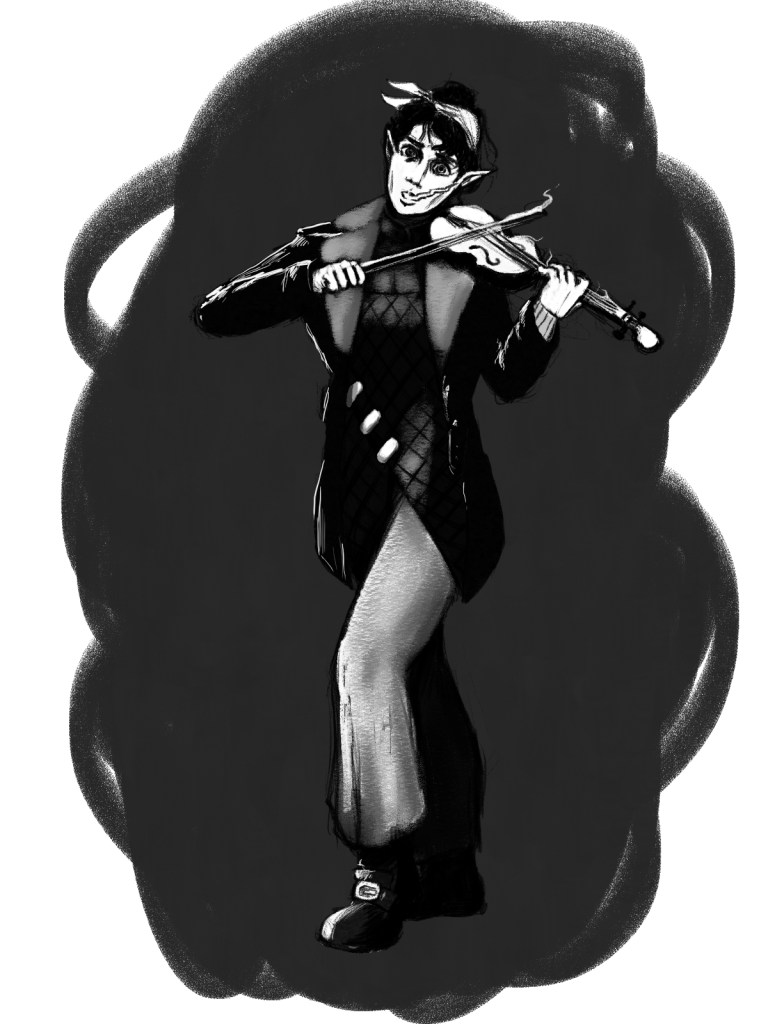
Alright, we’re ending our first week in October on a high (And hopefully fun) note, with a sort of pied-piper-but-for-zombies style Bard. To do this we’ve gotta break a few Bard Subclass conventions, particularly by adding an expanded Bard spell list.
“The Bards of the College of Haunting are experts at manipulating Necromantic energy and raising the dead with their strange and fevered magic. Whether through consulting ancient texts, or practicing long forbidden rites, a College of Haunting Bard is an Individual that has come into possession of the knowledge necessary to raise the dead and summon forth spirits. The abilities that are conferred onto a Bard seeking to practice this type of magic are as follows”:
Expanded College Spells: The following spells are added to the list of spells that a Bard can choose from upon leveling up:
Bard Level 3: Infestation, Toll the Dead, Inflict Wounds, Ray of Sickness
Bard Level 5: Animate Dead, Summon Undead
Bard Level 7: Blight, Shadow of Moil
Bard Level 9: Danse Macabre, Negative Energy Flood
Bard Level 11: Create Undead, Soul Cage
Dreadful Downbeat: When you join the College of Haunting at 3rd level, whenever an ally within 15 feet of you kills an enemy, as a reaction, you may do one of the following:
-Give the ally the benefits of a bardic inspiration until the end of your next turn.
-Grant the ally a number of temporary hit points equal to one roll of your bardic inspiration die plus your proficiency modifier.
-Make a ranged spell attack against an enemy within 15 feet of the killed enemy, dealing damage equal to one roll of your bardic inspiration die.
Unliving Waltz: Also at 3rd level, any Enchantment spells that you cast can target Undead as though they were Humanoids. This ability can also be used to overcome any related condition immunities in a target once per long rest.
Deathly Duet: When you reach 6th level in this class, when you give an ally a bardic inspiration die or they gain the benefits of one via Dreadful Downbeat, they can choose to expend that die to make use of the effects of Cutting In or, once you reach 14th level, Frenetic Quadrille once per die.
Cutting In: Starting at 6th level, you can expend a reaction to command any Undead creature under the control of the individual expending the reaction to take the damage from an attack that would otherwise hit an ally within 5 feet of it. Additionally, when you use this reaction on an Undead under your control, you may expend a Bardic Inspiration die to grant it temporary hit points equal to the die. At 14th level you grant double this amount in temporary hit points. When you or an ally activate this feature, you expend one use of “Cutting In”. This ability can be used a number of times equal to your proficiency modifier per short rest. For an ally to be able to make use of this feature, they must be within 60 feet of you.
Frenetic Quadrille: Starting at 14th level, when you use a bonus action to command any Undead under your control, you can instead issue up to four different commands, and distribute them amongst your Undead as you see fit. For an ally to be able to make use of this feature, they must be within 30 feet of you.
Note:
This subclass (And many that we’ll see going forward) was made with the intent of allowing players to have playstyles that can focus on tactics and synergies with their teammates, allowing for optional complexity on the part of the players without compromising the simplicity of 5E’s ruleset. This one in particular allows the bard to impose a good degree of battlefield control through its minions, and it allows it to synergize smoothly with any other Necromancy themed builds in the party, particularly Necromancy School Wizards or any Necromancy-minded Warlocks. In doing so, some of the wording for the subclass abilities may seem unclear. I’ve had it proofread, and I’ve made a few passes, but if there’s still anything that you as a reader may be confused on then don’t hesitate to leave a comment below, and I’ll try to make any necessary changes to help tighten up and clarify things.
Also! I would very much like to thank my players Quiver and Steven for helping with suggestions, balancing, and proofreading on this class!
 The Wyrm Scribe